- 53 monitoring missions
- 204 monitoring operations
- 49 green border monitorings
- 52 migrant interviews
- 50 interviewed migrants
The Independent Monitoring Mechanism (IMM) has published its
2025 Annual Report. The Report sets out what the IMM established in 2025 through its monitoring of police officers’ actions towards migrants in the area of border protection, irregular migration and international protection, with particular emphasis on respect for the principles of non-refoulement, the prohibition of collective expulsion, and the prohibition of torture and other forms of ill-treatment.
The Report’s central message is clear: in the monitored instances, a positive overall picture emerges regarding the police officers’ actions towards migrants. This assessment is neither idealised nor simplified. It is grounded in concrete data, collected on a strong methodological basis and analysed in line with high professional and scientific standards. At the same time, alongside widely evidenced best practices and functioning safeguards, the Report also records remaining challenges, several detected irregularities in individual cases, and areas where clearer institutional follow-up is needed.
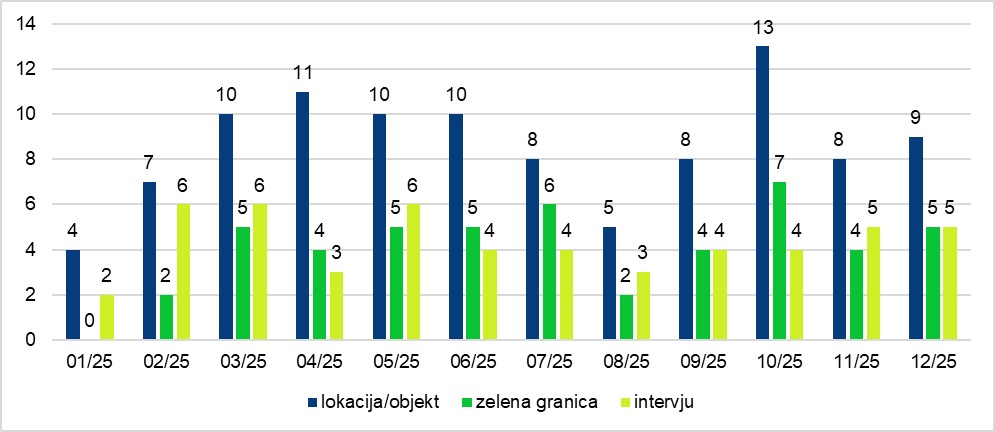
The weight of these findings stems from the strongest evidence base in IMM’s practice so far. During 2025, the IMM conducted 53 monitoring missions and 204 monitoring operations, including 49 green-border monitorings and 52 interviews with migrants. Monitoring was as a rule almost exclusively conducted unannounced. IMM monitors maintained an average weekly field presence, ensuring broad geographical and institutional coverage along the European Union’s longest external land border.
Monthly Distribution of all IMM Monitoring Operations in 2025
Source: IMM/2026
The IMM’s Annual Report is not a representative overview of all police actions in Croatia during 2025. Rather, it is a risk-based monitoring report grounded in targeted monitoring, documentation and data review, case-file analysis, interviews with migrants, on-the-spot checks, and follow-up verification. In 2025, the IMM employed a far stronger methodology than in previous years: it introduced standardised tools, built-in multilayer internal verification and quality control, and linked recommendations to specific findings rather than general impressions. In short, the Report's value lies not only in its conclusions but also in how they were reached.
The best practices identified in the Report are not isolated positive examples, but recurring patterns confirmed across multiple monitoring operations. After verifying and cross-checking migrant interviews against multiple sources, monitors found no irregularities or fundamental rights violations in police officers' conduct in 49 of the 50 unique migrant cases analysed. In 47 out of 50 cases, migrants did not raise any complaint or other grievance regarding police actions. In 50 out of 50 cases, they stated that they had access to food, water and toilets, while in 47 out of 50 cases they stated that they had been informed of the reasons for the restriction of their freedom of movement and of their rights in a language they understood. A similar picture emerges from location- and facility-monitoring: monitors had full access to all monitored locations and facilities, and in the large majority of cases safeguards were visibly functioning in practice rather than remaining merely formally prescribed.
The most visible challenges identified through IMM’s work relate to the uneven implementation of certain procedural and practical safeguards, particularly in the area of information on rights, access to interpretation, temporary accommodation conditions, and full adaptation for vulnerable migrant groups. In the interviews, negative indicators appeared only in a small number of cases, but they were not overlooked. On-site visits revealed the clearest challenges in temporary accommodation standards at certain police facilities, while police officers and monitors most often cited language/cultural barriers and insufficient staffing as key operational pressures.
The Report contains concrete recommendations that follow directly from the findings established on the basis of a methodologically processed evidence base. Since 2025, IMM’s recommendations have no longer remained confined to the annual reporting cycle, but have also been communicated to the Ministry of Interior after each monitoring mission, making them more timely, more specific and more operationally useful. The annual recommendations are grouped into six clearly defined clusters: access to international protection and immediate procedural safeguards; temporary accommodation and protection-sensitive conditions; health care, emergency medical services and psychosocial support; operational support conditions for rights-compliant practice; accountability, complaints, notification channels and follow-up obligations; and the continuation and further consolidation of independent monitoring.
The Report also shows that the IMM itself became methodologically and operationally stronger in 2025. During the year, public notification channels were established, through which more than 80 notifications were received relating to 38 identified concrete cases, while the IMM’s “Letter of Rights and Complaints” pilot procedure was successfully applied in 702 instances. Overall, this shows that 2025 was a year in which the IMM not only significantly intensified its field presence 3.8 times compared to the previous reporting period, but also matured methodologically—delivering findings into concrete recommendations much faster and more clearly distinguishing best practices from challenges needing further institutional action.
The IMM Report paints neither a picture of widespread non-compliance nor one of full compliance with all the relevant fundamental rights standards. Instead, it delivers a rigorous, verifiable, expert assessment of monitored instances in the context of police-migrant interactions. That assessment reveals a predominantly positive overall picture in the monitored instances: many safeguards were visibly operational in practice, though areas for further improvement remain. This is exactly why the Report matters—not just as a one-year overview, but as proof that independent monitoring delivers real value when it's systematic, methodologically robust, and tied directly to practical recommendations.